
Spokane City Directory Collections
Spokane County researchers have several overlapping shelves, not one complete run. The Washington State Library holds the broadest published sequence, including Spokane, suburban Spokane, northwest and southeast suburban editions, and later Spangle coverage. Spokane Public Library lists selected R.L. Polk volumes in Inland Northwest Special Collections. Washington State Digital Archives supplies a smaller but fully searchable name and business index. Confirm the exact year before planning a visit, because gaps occur in every catalog.
| Collection | Years | Where Held | Access |
|---|---|---|---|
| Spokane directories | 1892-2013, with gaps | Washington State Library | Request or visit; verify year |
| R.L. Polk sample holdings | 1885-2022, selected years | Spokane Public Library | Inland Northwest Special Collections |
| R.L. Polk name and business index | 1890, 1892-93, 1896 | Washington State Digital Archives | Free search and browse |
| Suburban editions | 1956-2013, with gaps | Washington State Library | Spokane-area and split editions |
The State Library's Spokane sequence includes 1892-93, 1895-1905, 1907-1924, 1926, 1929, 1938-42, 1947, 1950, 1952-92, 1994-2004, 2006-07, and 2009-13. Those spans are catalog holdings, not proof that each year is present. Spokane Public Library's catalog adds selected early and late volumes. Record the repository, year, page, and edition so another reader can reproduce the find.
Search Spokane Directory Names Online
The Washington State Digital Archives Spokane directory collection is the direct online route. Its R.L. Polk index covers four early volume years and reports 44,976 name and business records. Search controls include alphabetical browsing and Soundex, which groups surnames by how they sound.
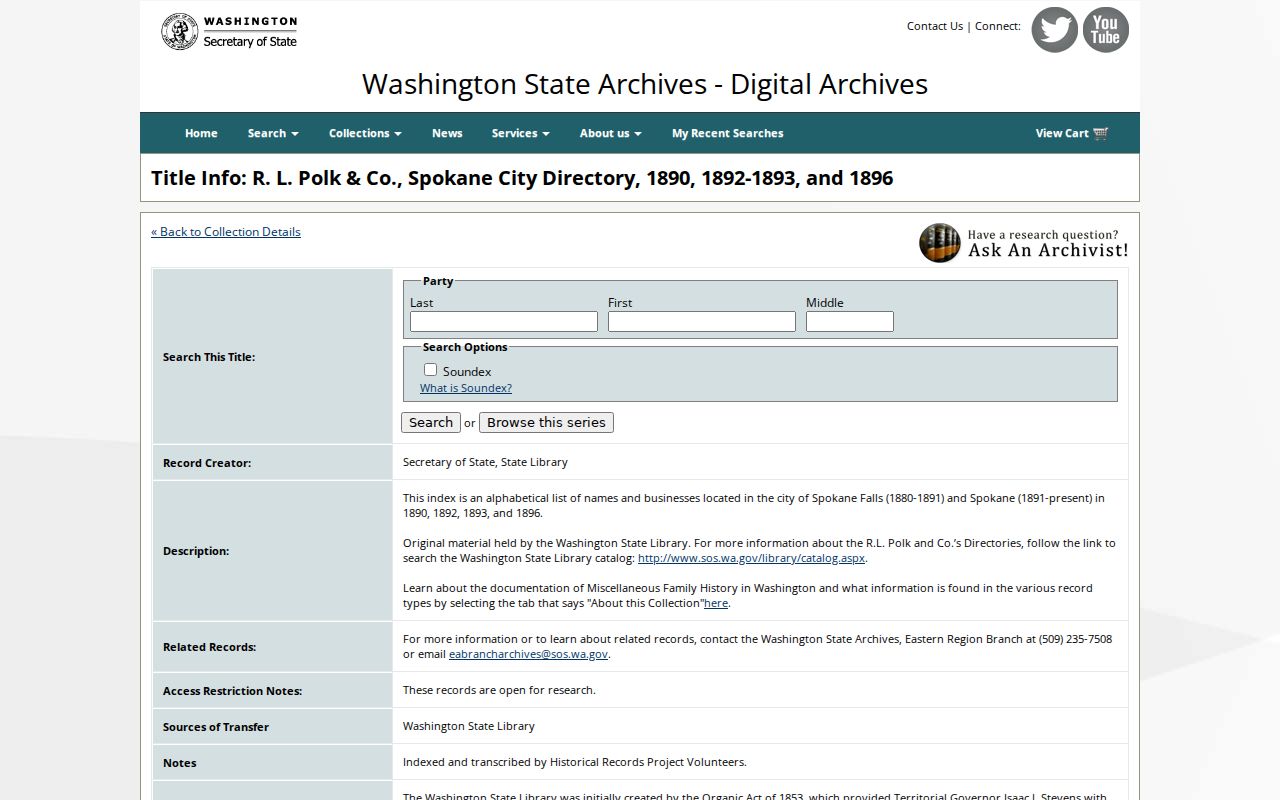
The capture shows the collection landing page rather than an individual resident. Use the hit to reach the source citation, then record the volume and page. Spokane Falls entries belong to the period before the city name changed to Spokane, so search both place names near that transition.
Spokane Library Directory Research
The Spokane Public Library genealogy collection brings directories together with obituary indexes, census microfilm, family histories, vertical files, plat and Sanborn maps, photos, newspapers, and databases. Inland Northwest Special Collections is on the Central Library's third floor. Staff can be reached at 509-444-5338 or nwroom@spokanelibrary.org when a catalog record does not make the edition clear.
The library page shows why a directory entry is a start, not a final answer. A name can be checked against an obituary, newspaper notice, map, or permit in the same research collection. Some licensed databases work only on library computers, so ask staff about on-site access.
Remote research should begin with the library catalog and a call or email to the special-collections desk. Give staff the exact year, likely surname, street variant, and whether the request concerns the main city or a suburban edition. For an in-person search, photograph or note the title page and abbreviation key before copying entries. Those pages identify the edition and explain marks that may differ from another year. If the needed book is not on the Spokane shelf, check the Washington State Library city-directory holdings and then the Eastern Regional Archives in Cheney. The archives is a useful next stop when a directory clue points to an older county record, assessor notebook, map, or boundary question.
Newspapers and obituary indexes can test what a printed address means. A death notice may explain why a name vanishes, while a business notice can show that the address was a shop rather than a home. Census microfilm helps confirm household members near a census year. Plat and Sanborn maps place the street and building in their period setting. None of those sources turns a directory line into proof of ownership, but together they can separate two similar names and show whether a move is plausible.
Reading Spokane City Directory Entries
Read the heading and abbreviation key before interpreting an entry. Formats shift by year, and the research did not confirm that every volume uses owner or renter symbols. Treat each printed item as a claim made by that edition. It may identify a resident, business, rooming-house occupant, or old address, but it does not prove present occupancy or ownership.
| Year and volume | The edition needed to place the entry in time |
|---|---|
| Name | Surname and given name, sometimes with household references |
| Work line | An occupation or business when printed |
| Street address | The listed house or business location |
| Later details | Telephone, neighborhood, ward, or spouse reference when printed |
- Criss-cross directory
- A directory arranged by street and house number instead of only by surname.
- Householder index
- An address-order list that connects one dwelling with the person printed there.
- Abbreviation key
- The volume's list of shortened words and marks; save it with any copied entry.
Copy the entry exactly before expanding any short form. Include the page citation, then compare the next volume. A missing person may have moved, died, changed names, been omitted, or gone unlisted. One blank year cannot distinguish those outcomes.
Spokane Directory Address Search
Spokane Public Library identifies 1929 as the practical breakpoint for address research. Polk directories from that year forward support address lookup to identify occupants. Earlier books generally require a person's name. For an old house, begin in 1929 or a later known year, obtain a candidate surname, and move backward through alphabetical lists.
The library's house-history resources connect directories with permits, assessor material, newspapers, Sanborn maps, and archives. Address variants can beat poor newspaper text recognition: try old street forms, shortened directions, and the exact spelling used in the printed volume.
Spokane City Directory Editions
The words “Spokane directory” do not always mean the same geographic shelf. The Washington State Library lists a main Spokane run, a Spokane Suburban series, and separate Spokane Suburban Northwest and Southeast editions. The suburban sequence begins with selected volumes from 1956, while the split northwest and southeast editions appear in the listed holdings from 2001 through 2013, with gaps. Spangle appears inside the southeast edition for 2006-07 and 2009-13.
Choose the edition by the place and year, not by title alone. A family outside Spokane city limits may appear in a suburban volume even when a catalog search suggests the main city directory. Ask the State Library to confirm the precise volume before requesting access. When an address falls near an old boundary, compare its directory label with county maps and the modern jurisdiction rather than assuming the publisher followed today's city line.
The listed suburban holdings are uneven: 1956, 1958, 1960-65, 1967, 1969-81, 1983-84, 1986-88, 1990-92, 1994-98, and 2000. The northwest and southeast runs list 2001-04, 2006-07, and 2009-13. Record each missing year as a catalog gap, not evidence that a household left Spokane County. Search the editions on both sides of the gap, then use newspapers, obituaries, or the nearest census to test continuity.
Spokane Directory Timeline
A short chronology keeps evidence tied to the right place name and search method. County boundaries and city labels changed, while publishers altered how books were arranged.
| 1885 | An R.L. Polk Spokane volume appears in selected library holdings. |
|---|---|
| 1890 | The earliest year in the searchable Digital Archives series. |
| 1891 | The indexed place label changes from Spokane Falls to Spokane. |
| 1929 | Polk address lookup becomes practical for occupant research. |
| 1956 | The listed Spokane Suburban run begins. |
| 2009-13 | The latest listed State Library Spokane and split suburban editions. |
A pre-1883 county record may refer to land outside today's Spokane County because the old county was much larger. Compare the date with historic maps before assigning a modern place.
The Eastern Regional Branch of Washington State Archives in Cheney is another fallback when the library shelf ends. It serves Spokane County and eight neighboring counties, which matters when a household crossed an old county line. Contact the branch with a name, date range, place, and known directory citation. Staff can then point toward county records, maps, or other series that may bridge a missing year.
Spokane County's record history also gives these books context. County voters selected Spokane as the seat in 1886, and the courthouse moved into its 1895 building with record vaults central to the design. A city directory is a private publication, but it becomes more useful when paired with public material preserved by county offices and archives. That pairing can test a move, family link, or property clue without asking one source to prove everything.
Trace Spokane City Directory Families
A year-by-year trail can fill the long space between federal censuses. Start from a confirmed name and keep a log of spellings, addresses, work lines, household references, edition titles, and page numbers. Each city directory entry should agree with at least one other source before it is treated as the same person.
- Find the first confirmed appearance and save its full citation.
- Check the prior and next available volumes, noting moves and spelling changes.
- Use the post-1929 address-order section to compare the household and nearby names.
- Pair the trail with the nearest census, newspaper, permit, or recorded document.
- When a name disappears, test an obituary, marriage index, cemetery record, or later address.
A marriage-index clue can resolve a surname change before the next search. Digital Archives holds Spokane County marriage indexes from 1880 forward, though an index is not a certified certificate. For a modern check after the historical trail ends, use the Spokane County resident lookup workflow.