
Spokane Previous Resident Sources
Start with the source closest to the time being studied. Spokane County has a strong modern parcel and recorded-document trail, while older household work depends more on library and archive collections. The sources overlap, but they do not all prove occupancy.
| Source | Years it covers | Where held | What it shows |
|---|---|---|---|
| Auditor land index | 1960–2026 | Recorder and Washington Digital Archives | Parties, dates, instruments, and indexed land facts |
| Plats and surveys | 1880–2026 | Washington Digital Archives and Recorder | Additions, lots, blocks, surveys, and mapped identity |
| Polk reverse directories | Address method from 1929 | Spokane Public Library and State Library | Historical occupants arranged by address |
| City and county directories | Spokane samples from 1885–2022; runs vary | Public Library, State Library, Digital Archives | Names, addresses, work, spouse, and later phones when printed |
| Federal census | Public after 72 years | Library databases, FamilySearch, and archives | Households at a census date |
| Building permits | County about 1930 onward; city split at 1993 | County and city permit systems | Work, dates, project roles, and address history |
| Sanborn maps | 1884–1952 | Library, Library of Congress, and archives | Building footprint and use context |
For a recent transfer, begin with SCOUT and the Recorder. For a mid-century household, begin with a reverse directory. Earlier research often starts from a known name, then uses an alphabetical directory, census, deed book, newspaper, or probate file.
Trace Spokane County Deeds Backward
The chain begins with today's parcel, not with a broad surname. SCOUT links the address to its parcel number, current owner, sales clues, and legal description. The newest deed or transfer then names the seller, called the grantor, and buyer, called the grantee. Reversing those roles one transfer at a time can identify earlier owners.
- Search the address in SCOUT. Save the parcel number, situs, legal description, current owner, and latest sale date.
- Find the related transfer in the Recorded Document Search, using an instrument number first when available.
- Record the grantor, grantee, document type, recording date, and legal-description link. Do not treat an index row as the whole deed.
- Search the seller as a grantee in an earlier purchase. Repeat while names, dates, and land descriptions align.
- For pre-1960 transfers, move to Recorder copies, deed books, the County Archive Center, Eastern Regional Archives, FamilySearch, or library sources.
The online index does not display every deed image. Copies can be requested at the Auditor/Recording counter, 1116 W Broadway Avenue, Spokane, Monday through Friday from 8:30 a.m. to 4 p.m.; by phone at 509-477-2270; or by mail to PO Box 2353, Spokane, WA 99210-2353.
- Grantor and grantee
- The grantor transfers an interest; the grantee receives it.
- Chain of title
- The ordered sequence of transfers affecting one property.
- Legal description
- The land identity used in recorded records, often more stable than a street address.
- Addition
- A subdivision name that may appear with lot-and-block details.
Spokane Land Records Online
Washington Digital Archives provides a useful second route for previous residents research. The Spokane County Auditor land-record series covers 1960 through 2026. Search controls include party surname or company, first and middle name, Soundex, party type, addition name, and a year range. The current year may be incomplete, and some images remain unavailable.
The Digital Archives land-record collection is shown below. Its party, addition, and year controls can recover a deed lead when a street name does not appear in the county index.
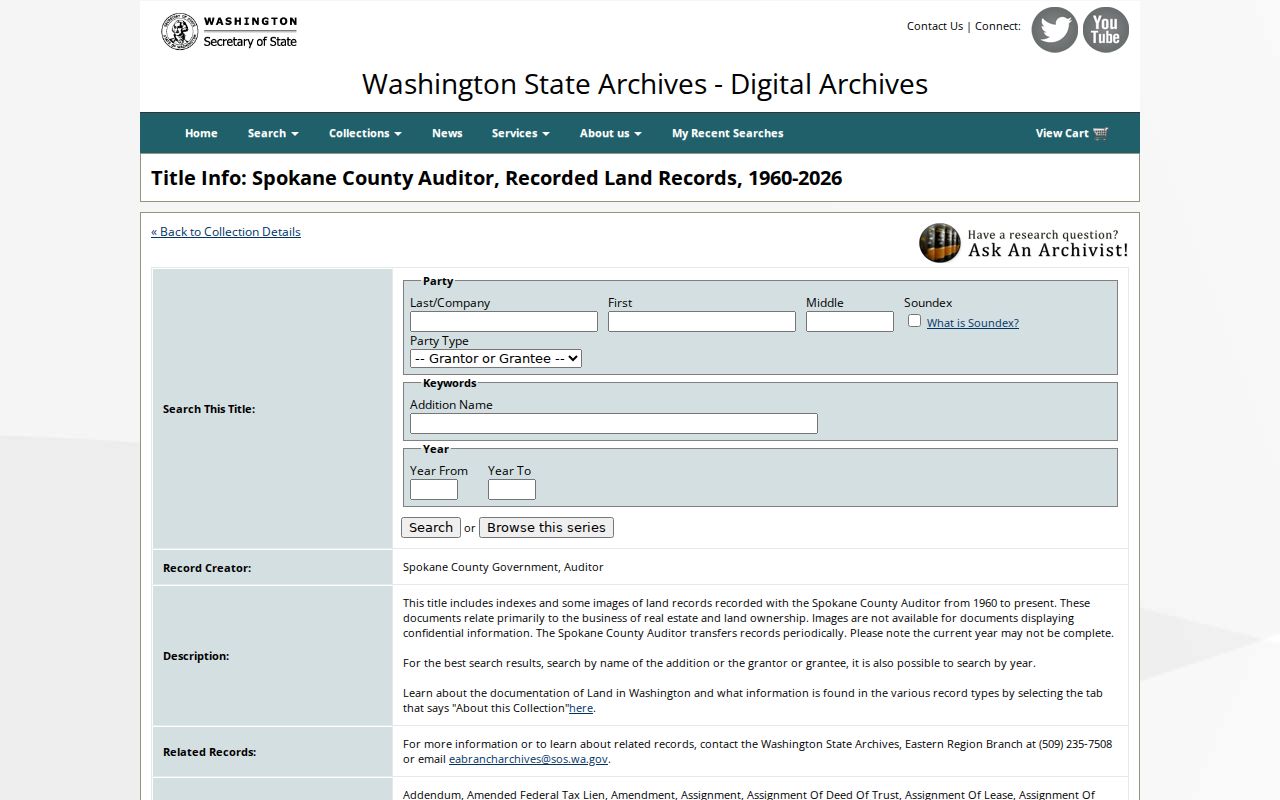
Search by addition and year when the legal description is known. Soundex can help with a surname variant, but every match still needs comparison against the parcel, instrument, and original document.
Note: The separate plats-and-surveys series reaches 1880, but a map or plat identifies land, not a household.
Spokane Previous Residents at Home
Spokane Public Library has a local house-history workflow that joins sources the county keeps apart. Permits can date work. Assessor material follows the parcel. Directories provide names by year. Newspapers add sales, social notices, deaths, and other dated events. Sanborn maps show the structure and its use at a point in time. The library also points researchers toward photographs and regional archives.
The Spokane Public Library house-history resource is captured below. Its source order is especially useful for a home with a long, mixed paper trail.
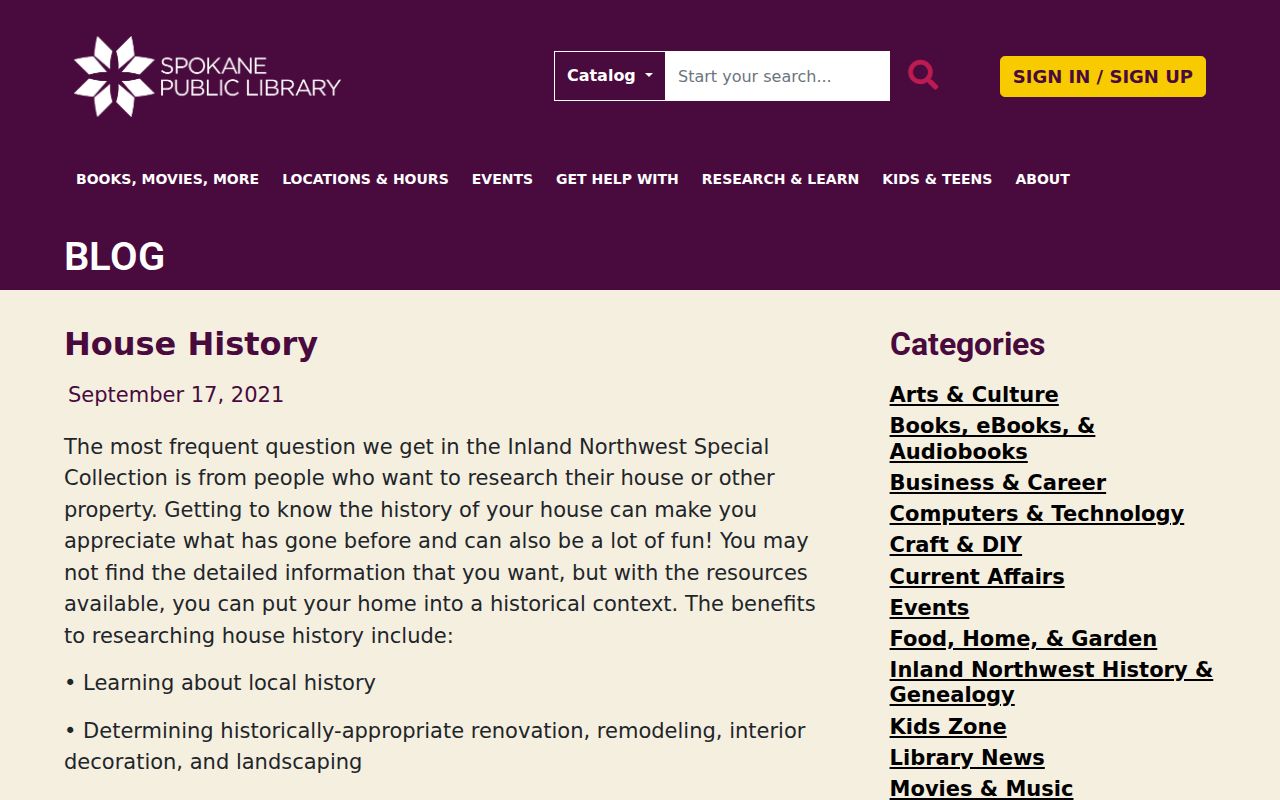
The library page turns a name into a research lead, not a claim of continuous residence. Keep a citation for each directory volume, permit, map sheet, article, or photograph.
Human-use tip. Search several forms of the same Spokane address to work around newspaper OCR, then confirm the result in a directory or parcel record.
Pair Spokane Directories and Census
Owners are only one layer of the story. A reverse Polk directory can name an occupant who never appears in the deed chain. Spokane address lookup becomes practical in volumes from 1929 forward. Earlier alphabetical volumes usually require a known surname. The nearest public census can then show the household at one ten-year point.
- Find the address in a 1929-or-later reverse directory and copy the occupant exactly as printed.
- Check the same address in the prior and next available volumes. Note gaps and changed street forms.
- Search that occupant in the nearest public census, using household names, age, work, and place of birth only as comparison points.
- Return to earlier alphabetical directories with the now-known surname, spouse, occupation, and address variants.
- Corroborate a move, death, or surname change through a newspaper, obituary, marriage index, probate record, deed, or permit.
Directory runs have gaps, and census years rarely match them. Absence from one year does not prove a move. The historical volumes and their full year ranges are described on the Spokane County city directory page.
Defeat Spokane Address OCR
The library's newspaper trail is unusually broad. Spokane papers from 1882 through 1894 are on microfilm, later papers begin in 1895, ProQuest Spokane coverage spans 1883 through 2009, and Spokane Chronicle coverage runs from 1890 through 1992. Optical character recognition, or OCR, turns scanned print into searchable text, but old type and tight columns often cause errors.
Try the directional before and after the number, abbreviate the street type, spell out the number, and remove punctuation. The house-history research gives forms such as “w 100 2nd,” “100 w 2nd,” and “w100 second.” Search the surname separately and pair it with a spouse, occupation, church, school, or business found in a directory.
Every useful article needs a citation card: publication, date, page or column, archive URL, scan quality, OCR confidence, and the record used to confirm it. This simple practice prevents a weak text hit from becoming an invented life event.
Spokane Previous Residents in Obituaries
The Spokane Public Library regional obituary directory reaches into the early 1900s. Search it before a broad newspaper OCR query. An obituary may connect a past resident to relatives, a church, an organization, a business, a funeral home, or a cemetery. Keep only the details needed to identify the right household, and verify the notice against another record.
Washington Digital Archives also hosts a Union Cemetery transcription with 505 people. Marker dates span 1881 through 2011, the earliest listed birth is 1819, and the first burial is identified as 1884. Relationship abbreviations can suggest family links, but the transcription is not proof of a current marker, an exact plot, or a complete cemetery population.
Probate records can extend a deed trail after an owner dies. The Spokane County Clerk holds probate files subject to sealing and access rules. Use the court viewer for discovery, then request the file or certified copy from the Clerk when the legal fact matters.
Date Spokane Homes and Streets
Sanborn maps cover Spokane beginning in 1884 with updates through 1952. They can show a building footprint, material, use, and nearby features. Read the sheet and update date carefully. A later pasted correction may describe a different time than the base map, and a building label does not identify a resident.
Permits supply a second building timeline. City files before 1993 are in the archive, later regular permits use the current portal, and the city permit map covers up to three recent years with nightly updates. County permit holdings reach to about 1930, with possible gaps before 1970. Applicants and contractors show roles in the project, not who lived there.
When a street number changes or cannot be found, use the legal description, addition, lot and block, parcel, old owner, map sheet, and nearby cross street. “Spokane Falls” may also be the correct place label for a nineteenth-century directory search.
Spokane Previous Residents Offline
The strongest fallback chain is local library, county counter, county archive, then regional or state archive. Spokane Public Library's third-floor Inland Northwest Special Collections holds directories, obituary indexes, census microfilm, family histories, vertical files, plats, Sanborn maps, newspapers, photographs, and yearbooks. More than 200 digitized Spokane high-school yearbooks cover 1911 through 1977.
The Washington State Archives Eastern Regional Branch is at 960 Washington Street in Cheney. It serves Spokane and nine neighboring counties, holds county and state record groups including assessor notebooks and registers, and accepts research appointments Wednesday through Friday. Contact the branch at 509-235-7500 or eabrancharchives@sos.wa.gov before traveling.
The County Archive Center itself searches by keyword, archive category, time period, and start and end date. Relevant labels include Property Tax & Assessments, permit statistics, and District Court name indexes. Preserve the old municipality and county name because Spokane County boundaries changed and the county seat moved from Cheney to Spokane in 1886.
Limits on Spokane Past Residents
A deed proves a recorded land transaction, not that each party lived at the parcel. A directory entry reflects one publication cycle and may omit people. Census schedules capture one date. Permits show work, while newspapers can contain errors. Previous residents should be reported as a dated, sourced trail rather than one seamless list.
Protected and sealed records stay outside the trail. Washington's Address Confidentiality Program shields substitute addresses for qualifying participants. Vital records follow state eligibility and archive-transfer rules. Utility accounts, motor-vehicle addresses, and delivery records are not an open household directory. A no-result may reflect privacy, a gap, a variant, or the wrong custodian.
Lawful use. Research Spokane County previous residents for family history, house history, heirs, preservation, or personal curiosity. Do not track, contact, threaten, stalk, harass, or harm a living person.
For a current street-wide parcel chain, use the Spokane County street directory. Keep older occupant findings anchored to the actual year, volume, page, or record number.